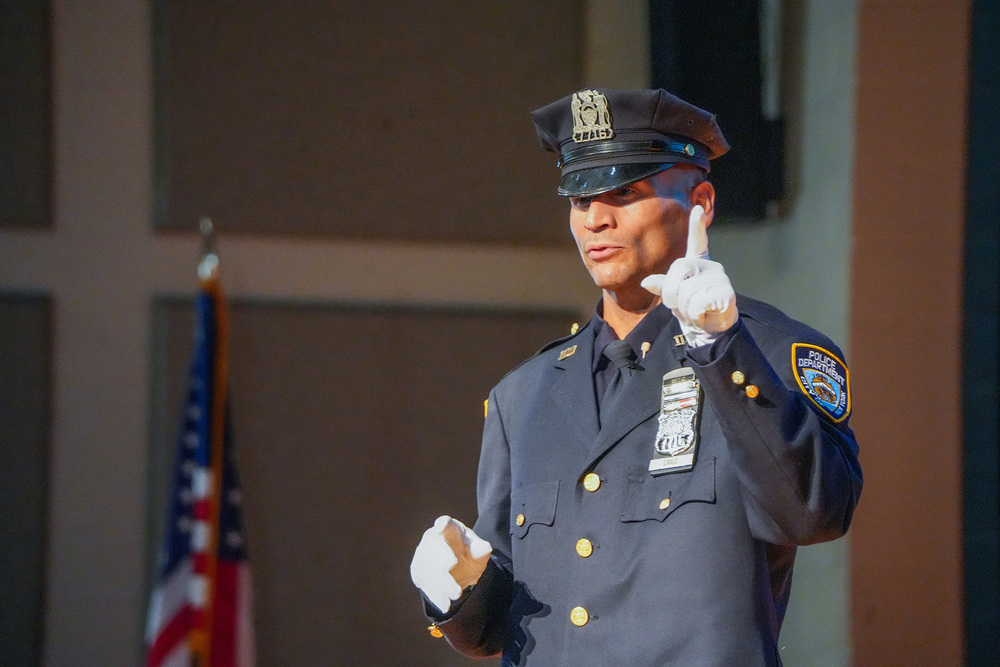
Taking the stage inside of Cane Bay High’s crowded auditorium, Felix Cruz brings attention to his outfit of choice for the day: his New York City Police Department dress uniform.
The garb is a formal, dark navy-blue paramilitary outfit that NYPD officers wear for special occasions including ceremonies and promotions.
Cruz wears this outfit for all of his public speaking events, but that does not make the process of putting it on any less difficult. In fact, Cruz tells the students it takes him two hours to get dressed in the uniform.
“Why?” he says. “Because I used this dress uniform to go to all the funerals after 9/11, and all the memories come back to me, and that’s why it takes me so long to put this on – but I do it for you, and I do it for my coworkers that never got to say goodbye to their loved ones.”
Cruz is a retired Horry County police officer who was working as a first responder in New York when the events of 9/11 occurred. While no longer in the line of duty, Cruz is now a public speaker who is committed to speaking about what he remembers from that day – not just to educate students, but to honor the lives lost during the attacks.
“You can never forget that day,” he told Cane Bay High students last Friday. “You ask any grown adult what happened that day, they’ll tell you exactly what they were doing – and how they felt – when that was going on.”
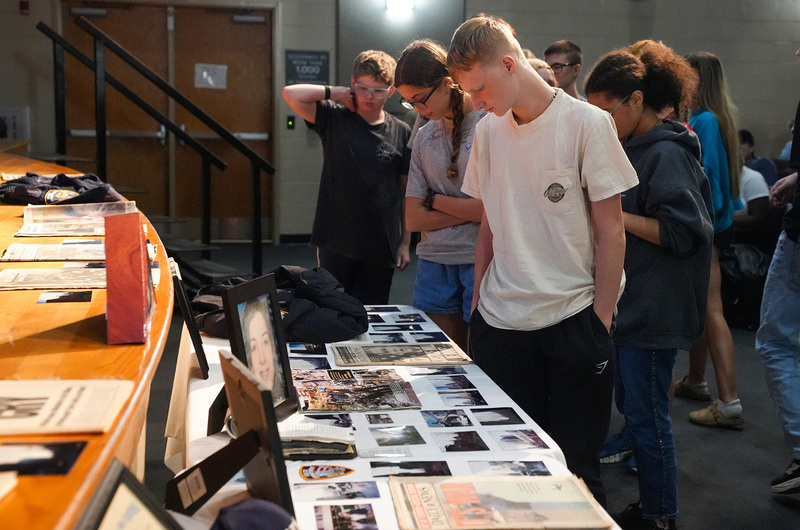
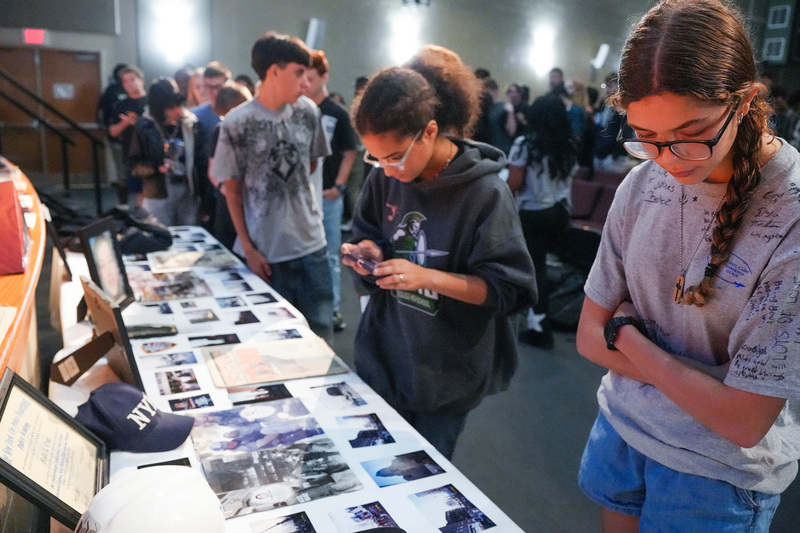
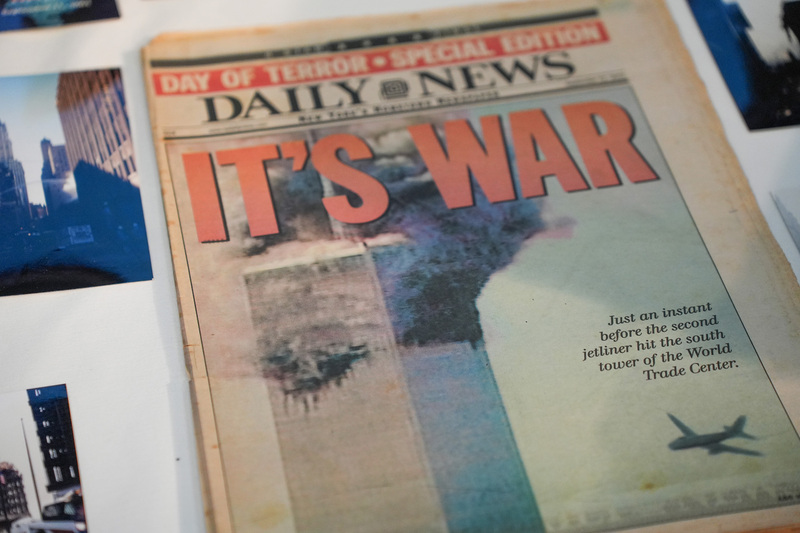
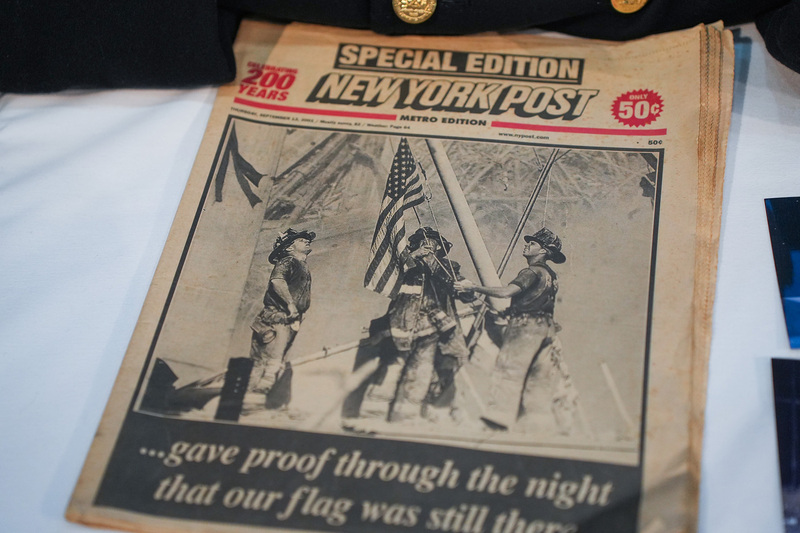
Cruz has previously spoken about 9/11 at Cane Bay High, but with this year being the 25th anniversary since the attacks, his presentation was extra important. His recollection of the days’ events serves a living history book, providing students with a firsthand account of how 9/11 affected everybody. His presentation included memorabilia from his time as police officer in New York; hats, jackets, uniforms and more. He also brought copies of old newspapers and magazines, all sporting sobering front page headlines and images that many adults remember all too well from 9/11.
“Today’s presentation means a lot to me because I get the opportunity to share my story,” he said.
‘We’re under attack’
Cruz started his career with the New York City Police Department in the 1990s. He was assigned to the 100th Precinct in Rockaway, Queens.
September 11, 2001 started off as a typical day for Cruz. He reported to his precinct at about 4:30 a.m. That day happened to be a primary election day in New York City, so at 5:15 a.m., Cruz was assigned election duty, and subsequently headed out to his post in a housing development.
“It was an ordinary day – nothing out of the ordinary at all,” he said.
At 8:46 a.m., the hijacked American Airlines Flight 11 smashed into the North Tower of the World Trade Center. The knee-jerk reaction was that it was a terrible accident, and all of New York – and beyond – immediately turned on the news to watch the event unfold.
Just 17 minutes later, at 9:03 a.m., United Airlines Flight 175 struck the South Tower. Cruz’s orders from dispatch: We’re under attack. Close down the polls, head back to your precinct – you’re being re-assigned.
“We were never trained for a terrorist attack,” Cruz told students.
By 10:38 a.m., both towers had collapsed. Cruz and his fellow precinct members arrived on the scene, tackling sheer chaos both in-person and over the radio.
“We had planes still unaccounted for. We didn’t know if there was going to be a suicide bomber, we didn’t know if they (the terrorists) were going up the subway system – we just did not know,” he said.
Many NYPD officers did not sleep at all on the night of 9/11, instead working continuous, 24-to-40-hour shifts on rescue and recovery at ground zero or securing perimeters. For those who did manage a brief rest, officers typically slept on makeshift cots, floors or basements inside their local police precincts.
Cruz reported directly to ground zero the following morning, arriving at a ghastly scene: everything was white, dust was still settling, there were active fires burning, adjacent buildings’ windows had been blown out, debris everywhere, crushed cars, different types of gas seeping from the ground, airplane parts – and many other things no one should be seeing, Cruz said.
“It looked like a bomb hit Manhattan,” he said, adding that the smell particularly resonated with him. “Something about ground zero and that smell…you’ll never forget that particular smell.”
On 9/11, 343 members of the New York City Fire Department perished, along with 71 law enforcement officers – including 23 officers from the New York City Police Department. Cruz explained to the Cane Bay students that firefighters wore Personal Alert Safety System (PASS) devices; these emit a piercing, high-pitched chirp automatically if a firefighter remains motionless for a certain amount of time, or it can be triggered manually. Throughout the following days at ground zero, first responders were haunted by the sound of the chirping coming from under the rubble.
As more days passed, responders would hear that sound less and less.
“We don’t know if they were still alive down there, or if the (PASS device) was being pressed on its own, but to us, they were alive – and our job is to help people,” Cruz said. “We did the best we could, and it wasn’t good enough. That is something we live with every day.”
Cruz detailed some of the other assignments given to him in the days following 9/11; he said one of the hardest ones was manning the barricades that surrounded the scene. After some time, first responders had to transition from treating ground zero as a rescue mission to a recovery mission. Responders knew they were no longer looking for survivors, but they could not let the public know that. Still, locals approached police officers at the barricades, holding up photos of their loved ones who had been in the towers, crying and asking, “Have you seen this person?”
“We did what our hearts told us to do: to comfort them,” Cruz said. “We hugged them. We kissed them…We cried with them, also.”
‘You are not alone’
Cruz served with the New York City Police Department for four years and relocated to South Carolina to serve as an Horry County police officer before retiring in 2017.
He now focuses on talking to students about his personal experiences from 9/11, and to encourage them to talk to their parents about what they remember from that day. His talk included a slideshow presentation of newspaper and magazine clips about the terrorist attacks, plus photos of the attacks and subsequent recovery efforts. He read aloud “A Part of America Died,” a well-known tribute dedicated to fallen law enforcement officers.
Cruz also talked about long-lasting health effects many experienced over the past 25 years. Since 9/11, more than 9,000 people have died from dozens of types of ground zero-linked cancers and respiratory diseases.
While he remembers 9/11 in full detail, Cruz also told students about how the country came together: that volunteers arrived from all over place to help clean up New York and provide comfort to locals; that people lined the streets, waving American flags to cheer on first responders as they came to and from the wreckage; that these people thanked the first responders and told them: You are not alone.
“We took a hit, but we bounced back, because we were united as one – and I couldn’t be prouder to be an American,” he said. “If you take anything away from this presentation, I hope you understand that.”
Most of Cane Bay High’s misty-eyed crowd consisted of social studies classes, AFJROTC cadets, and students from the school’s EMS and law enforcement classes. Students were allowed to ask him additional questions; one student asked what Cruz’s advice would be to students who are interested in a career as a first responder.
“Remember to support each other, and always be there for each other,” he said. “Whatever agency you work for…we are all together as one. We work together as one.”
Sophomore Ashton Wilson said getting Cruz’s firsthand accounts about 9/11 is very beneficial to students, as it brings to life something they talk about in class.
“It’s better to know his (Cruz’s) experiences than to actually read it or watch it,” Wilson said. “It’s someone who was actually there, and we can talk to them and ask them questions and get a deeper understanding of it.”
Senior Caroline Gebhardt has previously listened to Cruz’s talk at the school, but said this year’s presentation was particularly detailed and a lot more emotional – especially with the 25th anniversary in mind.
“History’s important, and it’s important to show that America can go through horrible things and still build from it,” she said.
Cane Bay High Career Specialist Jessica Galati said as the years continue to pass, opportunities for younger generations to hear firsthand accounts become increasingly important.
“Part of why I continue helping coordinate this event each year is because I want our students to understand why we continue to remember September 11 and to recognize the real people and individual stories behind such an important moment in our nation’s history,” she said. “I also think there is tremendous value in the lessons his story carries beyond the historical events themselves: service, courage, resilience, sacrifice and the importance of coming together as a community during difficult times.”