There is a saying some might be familiar with: “Hurt people hurt people.”
The meaning is pretty straightforward; the phrase indicates that individuals with unhealed emotional pain, trauma, or insecurity have the potential to inflict pain on others and subsequently demonstrate unhealthy behavior.
However, if one were to venture into Assistant Principal Stephanie Baird’s office at Cane Bay Middle, it would be evident almost immediately that the word “hurt” is not commonly used in her vocabulary. The uplifting signage on her office walls support positive mindsets:
“There’s no value in being angry.”
“There will always be someone who can’t see your worth. Don’t let it be you.”
“Be kind.”
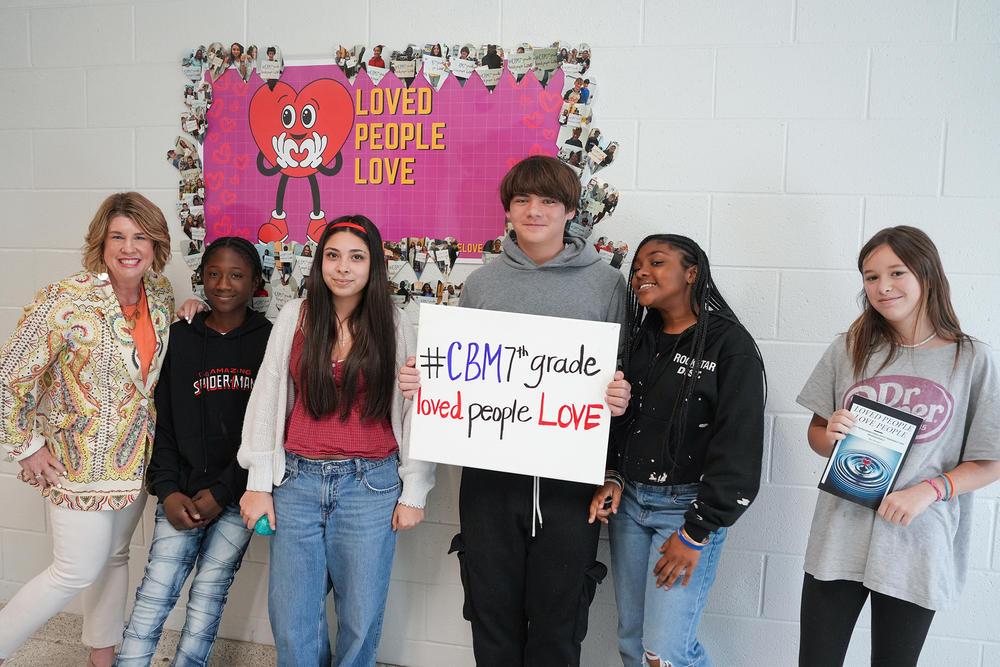
Of all the posters in her room, there is one that stands out most of all, and it reads: “#CBM7thGradeLovedPeopleLove.”
That word right there – “love” – is one that Baird uses a lot, as it stems from her goal to make sure every child she works with feels seen and loved.
It is a concept that is demonstrating success among the seventh graders at Cane Bay Middle, and churning out a good bit of positive referrals, and its all because of Baird’s efforts to create a safe and loving environment among her students.
This school year was Baird’s first one in an administrative role. Cane Bay Middle has three assistant principals, with each one serving as an administrator to the three grade levels. Baird is in charge of seventh grade.
Baird was previously an instructional coach at Sangaree Elementary but before that, she was a self-contained special services teacher at DuBose Middle in Dorchester District Two. Baird said her students at DuBose were often bullied for being perceived as different by their peers.
“I would see many of my students being hurt by others who just did not know them, and at the core of the bullying was hurt,” she said. “I taught my students that hurt people hurt, but ‘Loved People Love’.”
The phrase comes from the book “Loved People Love People” by Steve Kincanon, who does a deep dive into the idea that individuals who have experienced genuine love, kindness and compassion are not only more likely to reciprocate those emotions but are also catalysts for positive change in the lives of those around them.
Baird would show the students genuine love and challenge them to do the same in their response to others. The idea spread throughout class and grade level, and Baird’s efforts earned her a Teacher of the Year recognition at DuBose in 2019.
Flash forward to this school year, when Baird came to Cane Bay Middle, her first challenge was trying to figure out a way to connect with the school’s 450 seventh graders and start building relationships. She participated in a “town hall” style meeting with the grade level, printing copies of the first chapter from Kincanon’s book.
Fortunately, all 16 of the seventh grade teachers have bought in and supported the concept, and now Baird is using the same message to students who are hurting, as well as acting out with behavior.
Baird said she has seen students who were getting one to two referrals daily reduce their behavior and responses to situations. She has also seen teachers change their response to students acting out as well.
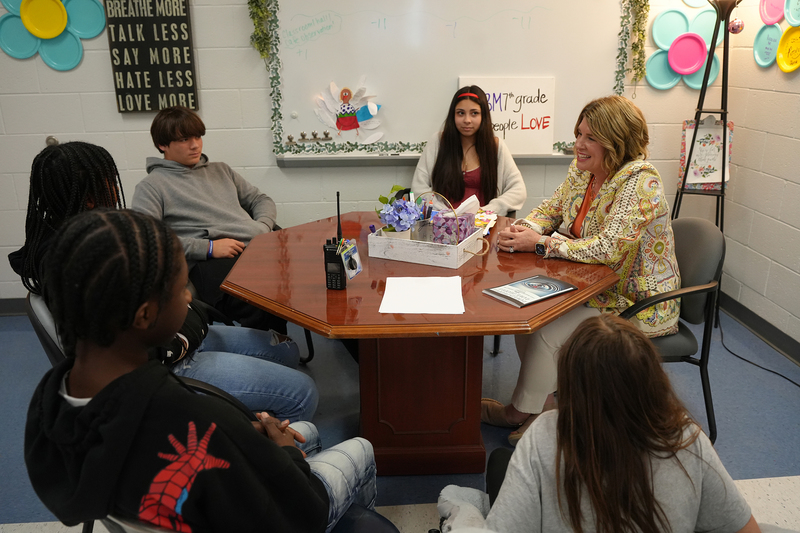
When a student gets sent to Baird’s office the first thing she asks the child is, “How are you showing love?” Follow up questions depend on the situation; if a child was disrupting a lesson, maybe she will ask, “How were you showing love for your teacher?” Her goal is to get the student to look inward and change the way they react in situations.
“I don’t like giving ISS. I don’t like giving OSS,” she said. “I do everything I can to do some sort of behavior intervention.”
She also has some incentives among the students and the teachers to help keep up the morale. The 16 seventh grade teachers are split into four teams, each one made up of a class from the four core subject areas. Every week, the teams work to not lose any “points,” which are deducted in situations like a teacher having to call Baird to come and talk to a class about their behavior, or if a student is sent to her office with a referral. The team with the most points by the end of the week gets to pick their reward: extra “team time” (recess), having class outside in the courtyard or enjoying music during lunch.
Teachers have the ability to send students to Baird for positive referrals too – these are accompanied with a letter explaining good behavior the child recently demonstrated. These students are rewarded by getting their picture taken with the “loved people love” sign, and the photo is cut into the shape of a heart and posted on the wall outside Baird’s office.
The seventh grade classes have come to expect Baird to make a “good morning” appearance at every classroom to start off the day. During her visits, Baird will give a daily challenge, like “try smiling all day and see what happens,” or “thank a teacher for something today.”
Of course, like any administrator, Baird still has discipline issues to tackle, but she has noticed a pretty significant shift from her students who were maybe more “intense” at the beginning of the school year compared to now; she asked five of them to weigh in on how they were able to turn things around and are now thriving at school.
While he admitted he is has been doing and feeling overall better at this point, Jayvion Perry was a little shy about sharing about how he has turned things around this past year. However, it is worth noting that Perry was a previous recipient of Baird’s weekly “loved people love”-themed award that she gives to students who have demonstrated good behavior. His teacher wrote that his growth has been inspiring, and that he has worked hard “to show compassion toward others, listen with understanding, and communicate more effectively with classmates and teachers.” The teacher said his efforts made the classroom “a more supportive place.”
Another student, Alivia Pivni, said she used to not want to contribute in class and would talk back to her teachers, but has since started getting better at completing her work and being more cooperative, thanks to Baird’s methods.
“I think it can encourage people to think about bad habits and think about how they can change their ways and get better,” Pivni said.
Jyiah Mayes described herself as “rough” closer to the start of the school year, but after working with Baird, she began to shift her perspective.
“I stopped getting into trouble and started doing better in school,” she said.
Jordan Brogdon said he has noticed a change in morale among his peers recently compared to the start of the school year – and that he himself has made an effort to be kinder to others.
“Mrs. Baird started talking about that book and it made me change who I was,” he said. “I have seen a lot of people who were rude and are now being nicer to the teachers and being nicer to staff.”
Sophia Albino said Baird’s methods have helped her look at her own behavior and remind herself to think before she speaks to avoid saying something that is potentially hurtful. She is also now challenging her friends to join the band wagon.
“When my friend says something mean (to me), I tell them to say three nice things – because that is what Mrs. Baird had me do,” Albino said.