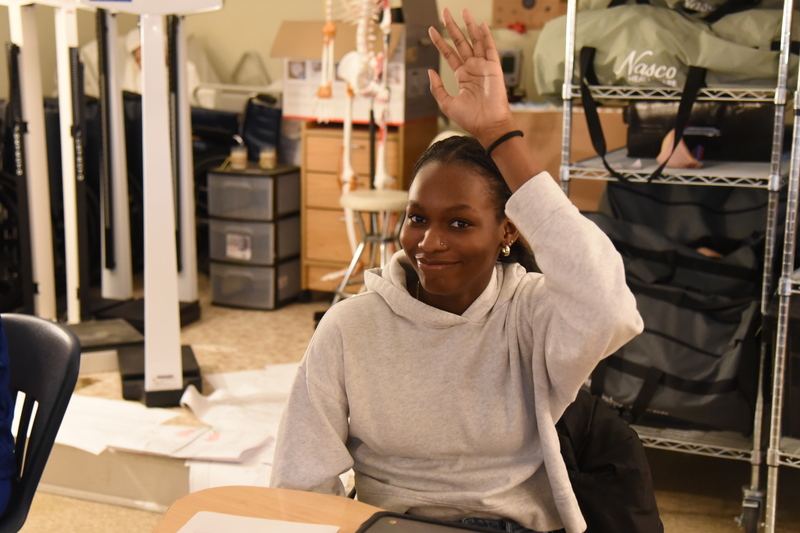

Throughout Berkeley County School District, our teachers conduct lessons that make a difference. In honor of Black History Month, Emily Trask had her Health Science 1 students present to their classmates a selection of African American historical figures who made their mark on the medical field. After multiple rounds of group presentations, students would compare the figures and vote on which one had the most influence on healthcare. Significant historical figures with the most votes would progress onto the next round of a bracket until the figure deemed to have the greatest impact by Mrs. Trask's class was crowned. Congratulations to Jane Cooke Wright, pioneering cancer researcher, on being the victor!
Who: Emilee Trask and her Health Science 1 class
Where: Berkeley High
What: To fully understand the influence of African American figures on the history of healthcare, students in Trask's Health Science 1 class were split into small groups to research and create a one-page visual presentation aid on one of the 10 African American historical figures.
Charles Richard Drew: An African American doctor who researched blood transfusions and developed improved techniques to store blood, eventually creating large-scale blood banks used during WWII.
William Augustus Hinton: A bacteriologist, pathologists and educator who was the first African American professor at Harvard University. Hinton created the Hinton test, a highly accurate blood test used to diagnose syphilis.
Daniel Hale Williams: An African American surgeon who founded Provident Hospital, the first non-segregated hospital in the United States. Williams is most known for performing the first successful open-heart surgery.
Mary Eliza Mahoney: The first African American licensed nurse.
Rebecca Lee Crumpler: The first African American female doctor of medicine. She was also one of the first female physician authors, publishing "A Book of Medical Discourses."
Marilyn Hughes Gaston: Gaston was the first black woman to direct the Bureau of Primary Health Care in the U.S. Health Resources and Services Administration. She is most famous for her work on sickle cell disease, where she discovered that through early detection children could begin immediate treatment and prevent septic infection from the disease.
James McCune Smith: The first African American to earn a medical degree. Smith became one of the nation's leading abolitionists, befriending Frederick Douglas and refuting pseudoscientific claims of black inferiority.
Jane Cook Wright: A pioneering cancer researcher and surgeon who developed the technique of using human tissue cultures rather than laboratory mice to test potential drugs on cancer cells, resulting in the eventual use of methotrexate to treat breast and skin cancer.
Leonidas Harris Berry: A physician in gastroscopy and endoscopy, Dr. Berry invented the Eder-Berry biopsy attachment for the Eder-Palmer gastroscope, the first direct-vision suction instrument used for taking tissue samples during gastroscopic examination.
Patricia Bath: An African American ophthalmologist, she became he first female member of the Jules Stein Eye Institute, where she established the Keratoprosthesis Program to provide advanced surgical treatments to blind treatments.
As groups were presenting, students in the audience were taking notes on each figure. Each figure was placed into a competition bracket. After all the presentations were completed, students voted on which figures had the most impact and the winners of each bracket progressed to the next round. After three rounds of voting and debate, Jane Cooke Wright was selected by the class as the figure with the most historical significance.
Results: Students were highly engaged in debating which historical figure had the most most impact on the healthcare field, especially once the field narrowed. This shows students absorbed the content beyond their assigned historical figure and understood the importance of these African American figures on the history of healthcare.