
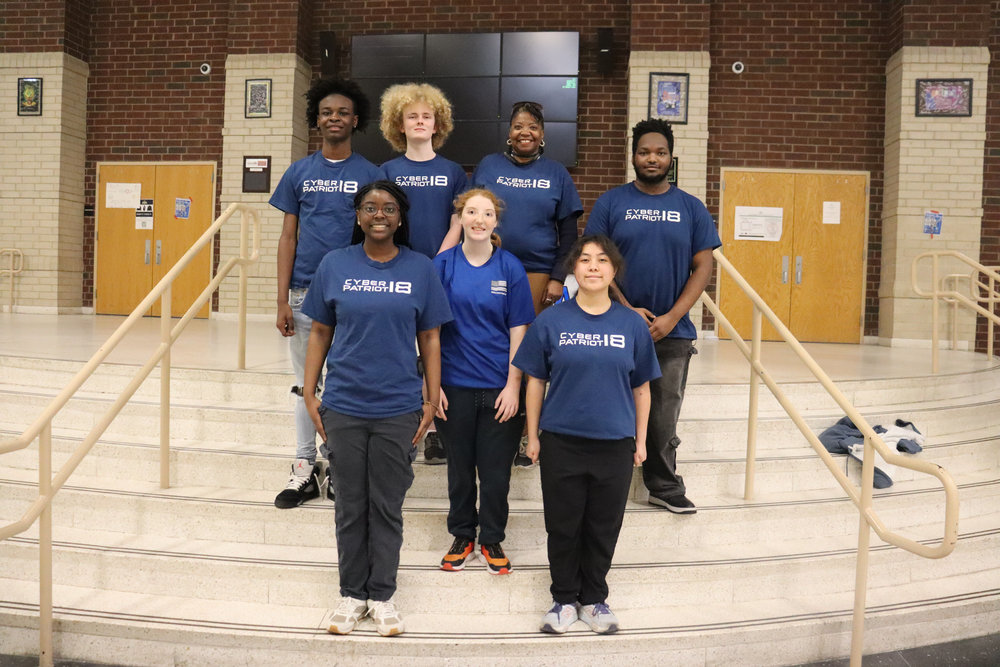
Students involved in Cane Bay High’s cybersecurity are actively working toward careers in a growing field designed to protect computer systems from outside threats.
The Cobra Ciphers had a busy year: they received a second place Gold Tier award in the Open division for CyberPatriot18, and then got invited to a local competition at Trident Technical College.
Under the direction of their coach, business education teacher Dr. Lavenia Anderson, the students are growing more confident in the areas of digital safety, network security and ethical hacking.
CyberPatriot is the National Youth Cyber Education Program, created by the Air & Space Forces Association to help guide students toward STEM careers. At the core of the program is the National Youth Cyber Defense Competition, the nation's largest cyber defense competition that puts high school and middle school students in charge of securing virtual networks. Through a series of online competition rounds, teams were tested on their ability to find and fix cybersecurity vulnerabilities in simulated environments, including windows and Linux operating systems.
Cane Bay High was one of two BCSD schools who participated in the most recent CyberPatriot season; READ MORE. The team was also invited to participate in Trident Technical College’s Palmetto Cyber Defense Competition – or PCDC – in April. They were one of 10 high school teams that competed.
This season’s Cane Bay team consisted of captain Alonzo Jenkins, Abigail Liron, Kevin Soll, Chase Owens, Skye Chavez, Hasan Sexton and Cameron Holmes. Anderson, who has led the club for three years, said she has had students who have gone on to explore careers in cybersecurity.
Some of the team members recently shared what it is like participating in these cybersecurity competitions. School teams are put in the position of newly-hired IT professionals tasked with managing the network of a small company. There are multiple rounds, with each one getting more difficult as a team works to a secure a system to the best of their abilities. One round can last several hours. The more secure a team makes a system, the more points they receive.
It takes a lot of teamwork and general technical skills to do well in a competition, but team members say their participation has also taught them organization, resilience, and how to carry themselves professionally.
“It teaches you real-world job experience,” Jenkins said, adding, “It’s a great learning experience. It teaches you a lot of teamwork, how to get used to working with people…It’s almost like we’re a family, even.”
Chavez said in addition to teamwork, the team members learn how to work independently.
“You can ask them for help, but a majority of the time…you also have that responsibility from both having to protect the system in the competition, and also practicing on your own outside of the club,” she said.
Soll added, if anything, even if a student enjoys working with computers but does not plan to a have a career in cybersecurity, the skills they are learning are just good to have personally.
“It’s a niche club,” he said. “Cybersecurity is almost like experiencing a technical college before actually going to a technical college, so it’s like you’re getting the experience before you even leave high school. There’s great demand for it in the world.”
Anderson commended her students for a good season.
“They did really well – everything they said they did, they did it really well,” she said.